Osteoporosis (OP) and osteoarthritis (OA) are highly prevalent musculoskeletal disorders that disproportionately affect post-menopausal women. These conditions, while pathologically and physiologically distinct, frequently coexist and share overlapping risk factors, including age, gender, hormonal changes, and systemic inflammation. The addition of chronic inflammatory conditions such as Lyme disease further complicates musculoskeletal issues by accelerating immune-mediated tissue damage and disrupting normal bone and cartilage homeostasis. [Huang].
A growing body of research highlights the central role of bone morphogenetic proteins (BMPs) in regulating bone remodeling, cartilage integrity, and intrinsic tissue repair [Bramlage]. Disruptions in BMP signaling provide an important biological link between osteoporosis, osteoarthritis, and inflammation-driven conditions such as Lyme disease.
Osteoporosis and Osteoarthritis in Post-Menopausal Women
OA is characterized by the progressive degradation of articular cartilage, subchondral bone sclerosis, and synovial inflammation. This degenerative process is driven by mechanical stress and pro-inflammatory cytokines, including interleukin-1β (IL-1β) and tumor necrosis factor-α (TNF-α), which induce cartilage breakdown and disrupt reparative pathways [Hunter]. OP is characterized by reduced bone mineral density (BMD) and the structural deterioration of bone tissue, resulting from an imbalance between osteoclastic bone resorption and osteoblastic bone formation. Estrogen deficiency, commonly seen in menopause, is a primary contributor to this imbalance, alongside oxidative stress and increased osteoclast activity [Chien; Yang]. Although OA and OP differ in their primary pathology, both conditions are influenced by age, sex, and genetic predisposition, and their coexistence creates a substantial clinical burden [Smith].
The post-menopausal state introduces a critical hormonal shift that accelerates both bone loss and joint degeneration, predisposing some women to progressive musculoskeletal issues, such as OA and OP. Estrogen plays a regulatory role in maintaining bone homeostasis and modulating inflammatory responses, but its decline with age and the onset of menopause results in increased bone turnover and heightened susceptibility to cartilage damage [Yang].
Lyme Disease and Chronic Inflammation
This vulnerability of post-menopause is further exacerbated in the presence of chronic inflammatory conditions such as Lyme disease—the most prevalent tick-borne illness in the United States and Europe [Smith]. Lyme disease is difficult to distinguish clinically in both acute and late stages. However, a hallmark of late-stage disease is Lyme arthritis, which develops in approximately 60% of untreated individuals and should be considered in the differential diagnosis of patients presenting with joint symptoms suggestive of OA or OP [Smith].
Following the tick-borne infection, bacteria such as Borrelia burgdorferi circulate through the bloodstream and localize within synovial joints, where they induce an exacerbated inflammatory response. This includes the infiltration of mononuclear cells, the accumulation of neutrophils, and the release of pro-inflammatory cytokines within synovial fluid. Additionally, the pathogen stimulates chondrocytes to produce matrix metalloproteinases (MMPs), which degrade extracellular matrix components, including collagen and proteoglycans [Smith]. Elevated MMP levels contribute to the progressive degradation of cartilage destruction, which further compounds the degenerative processes observed in OA. Lyme disease caused by B. burgdorferi can also infect bone, leading to significant bone loss, including osteopenia, by inhibiting osteoblasts [Oliveira]. High bacterial loads may induce further bone loss, as seen in OP, by disrupting osteoblastogenesis.
The BMP Connection
A distinct mechanism that links osteoporosis, osteoarthritis, and inflammation-driven conditions such as Lyme disease involves the dysregulation of BMPs—a group of growth factors within the transforming growth factor-beta (TGF-β) superfamily that play a central role in bone formation, cartilage maintenance, and tissue repair [Sartori]. They regulate the differentiation of mesenchymal stem cells (MSCs) into osteoblasts and chondrocytes, facilitate endochondral bone formation, and support angiogenesis and extracellular matrix deposition [Bramlage].
In OP, impaired BMP signaling—particularly involving BMP-2 and BMP-7—leads to reduced osteoblast activity and diminished bone formation [Durbano]. In post-menopausal women, estrogen deficiency further disrupts BMP signaling pathways by altering regulatory proteins such as inhibin A and reducing signaling efficiency [Wei]. This imbalance not only decreases bone formation but may also enhance osteoclast-mediated resorption, accelerating bone loss.
In OA, while BMPs are essential for cartilage repair, dysregulated or elevated BMP signaling, especially BMP-2, can induce chondrocyte hypertrophy and stimulate the production of catabolic enzymes, thereby promoting cartilage degradation [Davidson]. BMP activity is also implicated in osteophyte formation, a compensatory yet often painful response to joint instability.
Chronic inflammation, such as that observed in Lyme disease, further interferes with BMP-mediated processes by reducing beneficial BMP signaling, favoring osteoclast activity over bone formation, and impairing bone remodeling and cartilage repair by increasing inflammation, affecting bone metabolism similarly to menopause. As a result, post-menopausal women with concurrent inflammatory conditions face an amplified risk of accelerated bone density loss, joint deterioration, and impaired regenerative capacity.
Therapeutic and Clinical Applications of BMPs
Clinically, BMPs have been previously utilized in orthopedic medicine to promote bone healing and regeneration. BMP-2 and BMP-7 are approved for use in procedures such as spinal fusion and fracture repair, where they stimulate osteogenesis through direct osteoblast differentiation and indirect chondrogenic pathways [Raza, Sacrfi]. Emerging research has expanded interest in additional BMP subtypes, including BMP-6, which has demonstrated potential in improving bone mineral density and enhancing bone regeneration [Chiar]. The 2020 randomized controlled trial investigating BMP-6 in tibial defects reported improved BMD and accelerated bone remodeling compared to placebo [Chiar].
Furthermore, BMP-based complexes and peptide therapies, such as Cyplexinol®, are being explored for their ability to modulate BMP signaling more precisely. A 2023 clinical trial evaluating daily supplementation with a BMP complex (900 mg total serving; taken in capsule form twice daily; 450 mg in the morning and 450 mg in the evening) demonstrated significant improvements in joint discomfort, stiffness, and quality of life within 14 days [Pence]. These findings suggest BMP supplementation as a promising adjunctive role in managing both acute and chronic musculoskeletal conditions.
In summary, the link between osteoporosis, osteoarthritis, and Lyme disease in post-menopausal women reflects a complex interplay of hormonal decline, chronic inflammation, and disrupted BMP signaling. Understanding these interconnected pathways provides a more integrated framework for addressing bone and joint health, emphasizing the importance of targeting both structural and immunological factors in the management of age-related musculoskeletal disorders, particularly through beneficial supplements that contain natural BMP complexes.
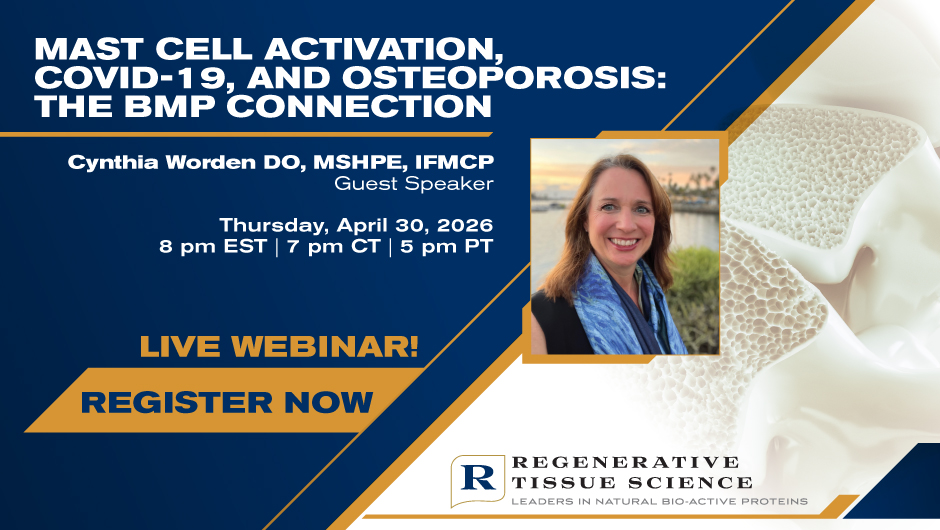
Upcoming Webinar:
Ostinol® is a natural, oral bone and joint health supplement powered by Cyplexinol®—a patented BMP-rich growth factor complex derived from bovine bone tissue. The regenerative-enhancing capability of Cyplexinol® provides a natural approach to reinforcing patients’ own biology shown in laboratory studies to grow new bone and cartilage tissue.
References
- Huang K, Cai H. The interplay between osteoarthritis and osteoporosis: Mechanisms, implications, and treatment considerations – A narrative review. Exp Gerontol. 2024;197:112614.
- Bramlage CP, Haupl T, Kaps C. Bone morphogenetic proteins in the skeletal system. Z Rheumatol. 2005;64(6):416-422.
- Hunter DJ, Bierma-Zeinstra S. Osteoarthritis. Lancet. 2019;393(10182):1745-1759.
- Chien KR, Karsenty G. Longevity and lineages: toward the integrative biology of degenerative diseases in heart, muscle, and bone. Cell. 2005;120(4):533-544.
- Yang JL, Hodara, Sriprasert I, et al. Estrogen deficiency in the menopause and the role of hormone therapy: Integrating the findings of basic science research with clinical trials. Menopause. 2024;31(10):926-939.
- Smith BG, Cruz Jr AI, Milewski MD, Shapiro ED. Lyme disease and the orthopaedic implications of lyme arthritis. J Am Acad Orthop Surg. 2011;19(2):91-100.
- Oliveira TC, Gomes MS, Gomes AC. The crossroads between infection and bone loss. Microorganisms. 2020;8(11):1765.
- Sartori R, Sandri M. BMPs and the muscle-bone connection. Bone. 2015;80:37-42.
- Durbano HW, Halloran D, Nguyen J, et al. Aberrant BMP2 signaling in patients diagnosed with osteoporosis. Int J Mol Sci. 2020;21(18):6909.
- Wei A, Leong A, Williams L, et al. BMP-7 in combination with estrogen enhances bone formation in a fracture callus explant culture. Tohoku J Exp Med. 2010;221(1):61-68.
- Davidson ENB, Vitters EL, Lent P, et al. Elevated extracellular matrix production and degradation upon bone morphogenetic protein-2 (BMP-2) stimulation point toward a role for BMP-2 in cartilage repair and remodeling. Arthritis Res Ther. 2007;9(5):R102.
- Raza FB, Vijayaragavalu S, Vaidyanathan AK. Bone morphogenetic protein as bone additive around dental implant and its impact on osseointegration: A systematic review. J Dent (Shiraz). 2022;23(2 Suppl):336-348.
- Scarfì S. Use of bone morphogenetic proteins in mesenchymal stem cell stimulation of cartilage and bone repair. World J Stem Cells. 2016;26:1-12.
- Chiar C, Grgurevic L, Bordukalo-Niksic, et al. Recombinant human BMP6 applied within autologous blood coagulum accelerates bone healing: randomized controlled trial in high tibial osteotomy patients. J Bone Miner Res. 2020;35(10):1893-1903.
- Pence J, Stockton M, Bloomer RJ. The dietary supplement Cyplexinol® alleviates joint pain in men and women. J Clin Transl Res. 2023;9(3):212-221.