
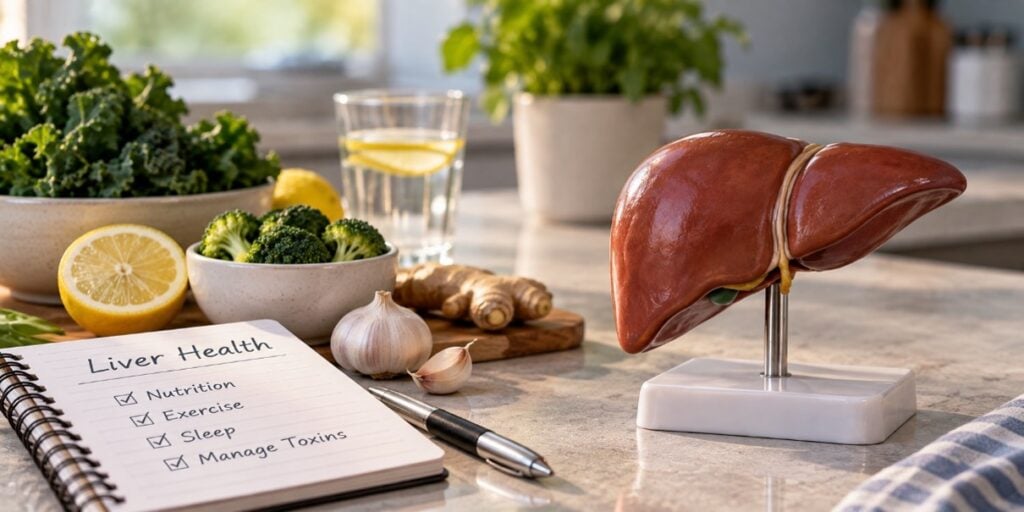
The liver does not need a juice cleanse. It does not need a pep talk, a green smoothie, or someone standing over it with a clipboard. It does rely on a genuinely busy antioxidant system — and N-acetylcysteine, better known as NAC, has a legitimate, well-earned seat at that table.
NAC is a modified form of the amino acid cysteine, and the body uses cysteine to build glutathione. This antioxidant helps cells manage reactive molecules produced by normal metabolism and by exposure to certain drugs or toxins. That’s the real biology behind why NAC keeps coming up whenever liver health does.
It’s also why hospitals reach for NAC when someone has taken too much acetaminophen. Enough acetaminophen drains hepatic glutathione fast enough that a toxic byproduct starts damaging liver cells directly. Timely NAC restores glutathione and serves as a standard, evidence-based antidote.
That emergency role is settled science. Taking NAC every day for general liver support is a completely different question—and it gets a completely different answer.
What the Evidence Actually Supports
NAC can replenish cysteine and support glutathione production. That much holds up under scrutiny. It also acts as a mucus-thinning drug and has been studied across respiratory, metabolic, psychiatric, and liver conditions — with results that swing depending on the condition, the dose, the delivery method, and how carefully the study was built. A benefit shown in one setting doesn’t automatically transfer to another.
For someone without a diagnosed deficiency, toxin exposure, or medical indication, no universal, evidence-based dose of NAC keeps an already healthy liver healthy. That doesn’t mean it doesn’t; it just means there’s no proof it does.
Here’s a rule worth keeping in a drawer for later: biochemical plausibility is where a research question begins. It is not where one ends.
So, Is Daily NAC Safe?
Oral NAC is generally well tolerated in studies and hasn’t been linked to clinically apparent liver injury. Its side effects are unglamorous, but not typically dangerous — nausea, vomiting, diarrhea, gas, and a sulfur smell that nobody is going to mistake for a “Summer Breeze” scented candle.
But “generally well tolerated” is not the same as “right for everyone.” NAC can amplify nitroglycerin’s blood-pressure-lowering and headache-reducing effects. Anyone with asthma, a bleeding disorder, active ulcers, a pregnancy, upcoming surgery, or a complicated medication list should run it past a clinician or pharmacist before starting.
Long-term safety data exist for specific patient groups. Still, supplement-grade studies use their own doses and formulations, which makes it hard to assess any sweeping promise about years of uninterrupted daily use. A clinician can help determine whether there’s a real reason to take NAC, how long makes sense, and whether anything should be monitored along the way.
The FDA Question
NAC’s regulatory status has generated a lot more heat than light. The U.S. Food and Drug Administration determined that NAC was authorized as a drug before it was ever sold as a dietary supplement. In 2022, the agency announced enforcement discretion for certain NAC-containing supplements while it kept working through the underlying question.
That policy keeps NAC on shelves. It does not mean every bottle of it has been reviewed or approved for safety, purity, or effectiveness. Quality varies from one product to the next, which is exactly why you should look up independent testing and read the label instead of the marketing copy.
NAC, Selenium, and the ‘More Is Better’ Problem
Selenium is required to make glutathione peroxidases, the enzymes that keep oxidative damage in check, and that single fact has grown into a tidy story: selenium and NAC as a perfectly matched antioxidant pair. The actual physiology is more restrained than the marketing. Most Americans already get enough selenium from food, and adding more on top of an adequate intake may do nothing at all for glutathione-peroxidase activity.
Too much, meanwhile, can cause hair and nail changes, nausea, nerve problems, and other forms of genuine toxicity. The useful question isn’t whether selenium is compatible with NAC. It’s whether there’s any actual reason to think intake is low — and if that’s unknown, a simple blood test answers it a lot more reliably than a bottle with two ingredients on the label.
“Generally well tolerated” is not the same as “right for everyone.” NAC can amplify nitroglycerin’s blood-pressure-lowering and headache-reducing effects. Anyone with asthma, a bleeding disorder, active ulcers, a pregnancy, upcoming surgery, or a complicated medication list should run it past a clinician or pharmacist before starting.
The same logic applies to stacking NAC with bromelain, curcumin, or nattokinase. Each has its own effects and risk profile, and a combination isn’t automatically validated just because the individual mechanisms sound like they’d get along at a dinner party.
A Better Daily Question
Skip the question of whether someone should take NAC every day — it’s the wrong scale. Ask instead whether NAC fits a specific goal, a specific health history, and a specific medication list, because that’s the scale where a real answer exists. For acetaminophen poisoning, the role is clear, and the evidence is settled. For everyday liver wellness, the case is a lot less dramatic than the label suggests.
The liver does serious work quietly, without asking for credit. Supporting it should start the same way it works — with a clear reason, a sober look at the evidence, and no motivational speech required.
Educational Note
This article is for general educational purposes only. It is not medical advice and does not replace care from a qualified health professional.
References
National Institute of Diabetes and Digestive and Kidney Diseases. (2016, November 7). Acetylcysteine. In LiverTox: Clinical and research information on drug-induced liver injury. National Library of Medicine. https://www.ncbi.nlm.nih.gov/books/NBK548401/
National Institutes of Health, Office of Dietary Supplements. (n.d.). Selenium: Fact sheet for health professionals. Retrieved September 10, 2026, from https://ods.od.nih.gov/factsheets/Selenium-HealthProfessional/
Samuni, Y., Goldstein, S., Dean, O. M., & Berk, M. (2013). The chemistry and biological activities of N-acetylcysteine. Biochimica et Biophysica Acta, 1830(8), 4117–4129. https://doi.org/10.1016/j.bbagen.2013.04.016
U.S. Food and Drug Administration. (2022, August). Policy regarding N-acetyl-L-cysteine: Guidance for industry. https://www.fda.gov/media/157784/download