Understanding Inflammation, Tissue Health, and the Role of Bone Morphogenetic Proteins
Chiropractors are on the front line of musculoskeletal care. Every day, they see patients struggling with joint discomfort, muscle strains, cartilage deterioration, reduced mobility, and other conditions that can interfere with activity, independence, and overall quality of life.
While inflammation is a normal and necessary part of the body’s response to injury and tissue stress, persistent or dysregulated inflammation can become an important factor in chronic musculoskeletal conditions. For healthcare professionals, this raises a larger clinical question: How can we support not only a patient’s symptoms, but also the biological processes involved in maintaining healthy musculoskeletal tissue?
This is where the emerging field of regenerative nutrition warrants attention.
Inflammation and the Musculoskeletal System
Musculoskeletal injuries and degenerative conditions can affect muscle, tendons, ligaments, cartilage, joints, and bone. Although the underlying causes vary, inflammation is frequently part of the biological response.
Two common examples are muscle sprains and strains and cartilage damage associated with osteoarthritis.
Following an acute injury, inflammatory signaling helps initiate the body’s repair response. In a healthy process, this response is controlled and eventually resolves. When inflammation persists, however, the local tissue environment may remain under stress, potentially affecting mobility, comfort, and normal tissue maintenance.
In osteoarthritis, the picture is even more complex. The condition involves far more than simple mechanical “wear and tear.” Changes can occur throughout the joint environment, including cartilage, subchondral bone, synovium, and surrounding tissues.
For clinicians managing patients with chronic musculoskeletal concerns, addressing this broader biological environment may provide an important complement to traditional mechanical and rehabilitative approaches.
Looking Beyond Symptom Management
Chiropractic care has traditionally focused on restoring movement, improving function, and addressing mechanical contributors to musculoskeletal discomfort. Nutrition provides an opportunity to support patients from another direction: their underlying biology.
Rather than considering nutrition solely in terms of vitamins and minerals, advances in musculoskeletal science are drawing attention to the signaling proteins the body naturally uses to regulate cellular activity.
Among these signaling proteins are bone morphogenetic proteins, or BMPs.
What Are Bone Morphogenetic Proteins?
Despite their name, BMPs are involved in biological processes extending beyond bone alone.
BMPs are naturally occurring signaling proteins within the transforming growth factor-beta (TGF-β) superfamily. They participate in cellular communication associated with the development, maintenance, and remodeling of musculoskeletal tissues.
Certain BMP signaling pathways are associated with the differentiation of progenitor and stem cells toward specialized cell types involved in bone and cartilage biology, including osteoblasts and chondrocytes.
This makes BMP signaling particularly interesting when considering musculoskeletal health from a tissue-support perspective.
Instead of asking only, “How do we reduce discomfort?” the evolving conversation becomes:
“How can we nutritionally support the biological environment and signaling processes associated with healthy musculoskeletal tissue?”
A New Conversation in Chiropractic Care
Patients increasingly want more than temporary solutions. They want to remain active, maintain mobility, and preserve their ability to participate in the activities that matter to them.
That makes the chiropractor’s role particularly important.
By understanding the relationship among inflammation, musculoskeletal tissue health, BMP signaling, and emerging nutritional technologies, chiropractors can broaden the conversation from managing musculoskeletal symptoms to supporting the biological environment necessary for long-term musculoskeletal health.
Continuing the Discussion – join the webinar:
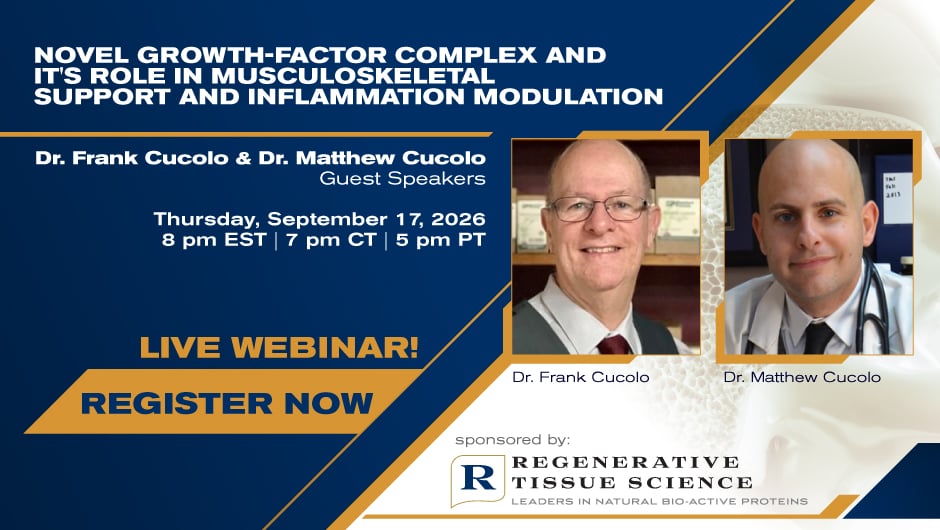
In the educational webinar, father-and-son chiropractic team Drs. Frank and Matthew Cucolo explore these concepts from the perspective of practicing clinicians.
Their discussion examines:
- Common musculoskeletal conditions, including muscle sprains and strains
- Cartilage damage and osteoarthritis
- The effects of inflammation within musculoskeletal conditions
- The biological role of bone morphogenetic proteins
- The emerging science surrounding naturally derived growth-factor complexes
- How regenerative nutrition may complement a comprehensive approach to musculoskeletal support
As our understanding of cellular signaling and musculoskeletal biology continues to evolve, the opportunity for healthcare professionals is significant: to connect mechanical care, nutritional science, and tissue biology in a more comprehensive approach to supporting patients throughout the aging and recovery process.